Cy Twombly
April 25, 1928 – July 5, 2011
Cy Twombly, who died on July 5 aged 83, was a reclusive American painter whose work was so individual it barely needed a signature.

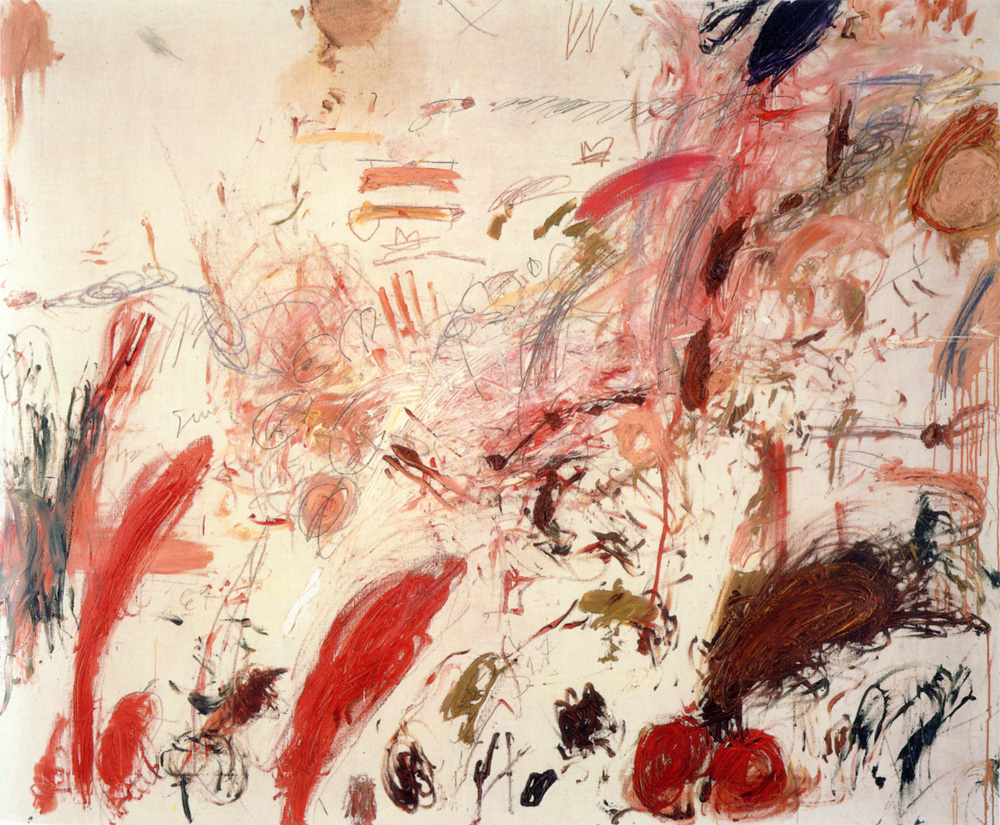
Consisting almost entirely of scribbles, feints and graffiti-like gestures, his art divided critics and public between those who became addicted to its sensuous, reticent nature and those who considered it incontrovertible proof of the fraudulence of modem art.
Although a child could perhaps have produced a single doodle as delicate or as balanced, none could have created the subtle tension and animation of line that Twombly maintained throughout his long career.
Unusually for an artist who emerged in the monumental shadow of Abstract Expressionism, his art remained impervious to fashion. Obsessed by Classical antiquity, he addressed his central theme — the passing of time — in paintings, drawings and sculptures that, if they were not actual palimpsests, beautifully evoked ideas of erasure and loss.
An expatriate living in Rome, for many years Twombly was overlooked by a New York art world obsessed with Pop and minimalism. But gradually his range of classical reference, his jazz-like improvisations and the reductive sense of loss his work engendered won a wide audience. Eventually his best works were valued in the millions of dollars .
Edwin Parker Twombly Jr, who always used his father’s nickname, Cy, was born at Lexington, Virginia, on April 25 1928. Cy Snr had been a major league pitcher and was a swimming coach at Washington and Lee University in Lexington.
After high school, where he became fascinated by Classical history and mythology, the young Cy studied art for a year each at Boston Fine Arts and at Washington and Lee, before enrolling at New York’s Art Students League on a Museum of Virginia scholarship.
There he met the “protean genius” Robert Rauschenberg, who suggested he attend the Black Mountain College in North Carolina, the fount of avant-garde American art. At Black Mountain he was taught by Robert Motherwell and Franz Kline, titans of the New York School.
In 1952 Twombly and Rauschenberg travelled to Morocco and Rome, and on their return to Manhattan shared a Fulton Street loft. They remained lifelong friends. Although their work was totally distinct, Twombly’s abstractions bearing no relation to his friend’s “found” and assembled collages, at their joint show at the Stable Gallery in 1953 they attracted equal scorn. If some critics suggested affinity between Twombly and the graffiti artists, it was to the European “art informal” of Jean Dubuffet and the inscriptions on Classical ruins rather than the spray-can kids that he turned.
Twombly’s early works were subsequently called the “white paintings”, but it was an artificial distinction arising from the seamlessness of his entire output. Technically and thematically, his stylistic shifts over the years were solely of nuance. There were no dramatic revelations, just a persistent interest in “temps perdu” and a determination to register his mark.
After serving in the US Army code-breaking division, where he became famous for “automatic drawing” under his bedclothes at night, he enjoyed another show at the Stable Gallery. If its reception was not noticeably warmer (one critic observed: “A bird seems to have passed through the impasto with bitter screams and cream-coloured claw marks”), the show did include Panorama (1955), later considered to be his first masterpiece.
This work responded to the monolithic energy and lyricism of Pollock’s Autumn Rhythm by reducing it to fluid, white marks on a grey-black ground. Using an earthy mix to slow the paint, and nervy scratchings to accelerate it, Twombly was the first artist to mesh the vocabulary of Pollock’s cursive linear abstraction with the loopier, body-based work of de Kooning and create genuinely original art.
After heading the art department at the Southern Seminary Junior College in Buena Vista, Virginia, Twombly left for Rome in 1957, returning to America only for brief visits. As an American in Rome, he was no more an outsider than he had been as the Southern gentleman in New York or the avant-garde artist in Virginia.
In Rome, his work began to include deceptively childlike, often partly obscured, place names amid the hatching in addition to elements that recalled particular places or cultural signposts. He became increasingly interested in Classical allusions that were sometimes heavy-handed, and a work such as The Second Part of the Return from Parnassus played both with the myth itself and Poussin’s idealised painting of it.
In 1963 he exhibited the nine-panel Discourses on Commodus, in which he used the rise and fall of the emperor as a metaphor for the creativeness and destructiveness of artistic endeavour. The show was panned by a solipsistic New York art world, but even Twombly’s supporters admitted that the show suffered from “a surfeit of prettiness”. His was not an art that demanded large canvases; it was a fragile, introspective art using the manner of American abstraction to muffle emotion.
In the late Sixties the “white paintings” were replaced by the “grey paintings”, but the interests remained the same. Living in virtual seclusion in a palazzo in Rome, Twombly was able to resist the siren call of fashion. Constantly mixing his media, he drew on paint-covered canvas, painted on drawing paper and began to assemble collages, silk screens, etchings and assorted ambiguous (and invariably untitled) constructions that worried away at his chosen themes.
Twombly said, in one of his rare recorded utterances, that he had “a feeling for paper rather than for paint”, and no one disputed the precedence of line over colour in his work or that he painted like a draughtsman. His lines recalled Paul Klee’s in their anxious elegance, and he experimented with pencil angles to flatten or sharpen tone.
Twombly was never afraid of the grand gesture, and Fifty Days at Iliam (1978) was a 10-part work in oil, crayon and pencil on a combined canvas of nine by 85ft that portrayed the tension and violence of Homer’s Iliad through scribbled and scratched metaphors.
Although many critics queued up to praise the work, there were dissenting voices — among them that of Robert Hughes, who observed that a Classical title does not necessarily portend a Classic work. Rather, he thought, Twombly was closer to Post-Modernism’s “skittering, rather affectless quotation, the shoring of fragments against the ruins”. Hughes nevertheless allowed that Twombly was “still a considerable painter”.
In the early Eighties Twombly started experimenting with colour — “a rush of wild mauves, greens and cosmetic pinks” — but the works were not considered a success. Rather his best work was “like looking into the endlessly moving depths of an immense body of water” and did not lend itself to outbursts of emotion — one critic called Twombly’s Hero and Leander (1982) “as gushily romantic as a teenager’s valentine”.
Returning to the style of his masterpieces, Twombly enjoyed major retrospectives at the Whitechapel in London in 1988 and at the Museum of Modern Art in New York in 1994. If the Americans were slow to appreciate his work (that it was almost impossible to reproduce successfully scarcely helped), when they finally responded it was with absolute enthusiasm. As graffiti artists such as Jean-Michel Basquiat dominated the galleries and headlines of the late Eighties, so Twombly’s shy, long-haul achievement swung into sharp focus.
Elected to the American Academy and Institute of Arts and Letters, he represented America in the Resident Foreign Artists section of the 1988 Venice Biennale, where his works were described as “almost Monet-like in their atmospheric brushwork and all-over patterns”. He won the Golden Lion at the 2001 Biennale.
Final confirmation both of his originality and importance came in 1995, when the $5 million Cy Twombly Gallery opened in Houston. Although his work was owned by galleries around the world, this was the first permanent collection of an artist whom The Daily Telegraph described as “a rare spirit ... who paints like no one else and who explores a realm of feeling touched only by the greatest poets”. In 2008 there was a retrospective at Tate Modern, and last year he completed an enormous ceiling painting for the Salle des Bronzes in the Louvre.
A man who shunned publicity, Cy Twombly lived in an enormous palazzo where he collected the art not only of antiquity but also of his contemporaries. He also owned a country house overlooking the Tyrrhenian Sea at Gaeta. They were described by a visitor as houses “a connoisseur would swoon over and a thief would leave untouched”.
He married, in 1959, Tatia Franchetti. She died in 2010, and he is survived by their son and by his longtime partner Nicola Del Roscio.

After high school, where he became fascinated by Classical history and mythology, the young Cy studied art for a year each at Boston Fine Arts and at Washington and Lee, before enrolling at New York’s Art Students League on a Museum of Virginia scholarship.
There he met the “protean genius” Robert Rauschenberg, who suggested he attend the Black Mountain College in North Carolina, the fount of avant-garde American art. At Black Mountain he was taught by Robert Motherwell and Franz Kline, titans of the New York School.
In 1952 Twombly and Rauschenberg travelled to Morocco and Rome, and on their return to Manhattan shared a Fulton Street loft. They remained lifelong friends. Although their work was totally distinct, Twombly’s abstractions bearing no relation to his friend’s “found” and assembled collages, at their joint show at the Stable Gallery in 1953 they attracted equal scorn. If some critics suggested affinity between Twombly and the graffiti artists, it was to the European “art informal” of Jean Dubuffet and the inscriptions on Classical ruins rather than the spray-can kids that he turned.
Twombly’s early works were subsequently called the “white paintings”, but it was an artificial distinction arising from the seamlessness of his entire output. Technically and thematically, his stylistic shifts over the years were solely of nuance. There were no dramatic revelations, just a persistent interest in “temps perdu” and a determination to register his mark.
After serving in the US Army code-breaking division, where he became famous for “automatic drawing” under his bedclothes at night, he enjoyed another show at the Stable Gallery. If its reception was not noticeably warmer (one critic observed: “A bird seems to have passed through the impasto with bitter screams and cream-coloured claw marks”), the show did include Panorama (1955), later considered to be his first masterpiece.
 |
| Lepanto |
This work responded to the monolithic energy and lyricism of Pollock’s Autumn Rhythm by reducing it to fluid, white marks on a grey-black ground. Using an earthy mix to slow the paint, and nervy scratchings to accelerate it, Twombly was the first artist to mesh the vocabulary of Pollock’s cursive linear abstraction with the loopier, body-based work of de Kooning and create genuinely original art.
After heading the art department at the Southern Seminary Junior College in Buena Vista, Virginia, Twombly left for Rome in 1957, returning to America only for brief visits. As an American in Rome, he was no more an outsider than he had been as the Southern gentleman in New York or the avant-garde artist in Virginia.
In Rome, his work began to include deceptively childlike, often partly obscured, place names amid the hatching in addition to elements that recalled particular places or cultural signposts. He became increasingly interested in Classical allusions that were sometimes heavy-handed, and a work such as The Second Part of the Return from Parnassus played both with the myth itself and Poussin’s idealised painting of it.
In 1963 he exhibited the nine-panel Discourses on Commodus, in which he used the rise and fall of the emperor as a metaphor for the creativeness and destructiveness of artistic endeavour. The show was panned by a solipsistic New York art world, but even Twombly’s supporters admitted that the show suffered from “a surfeit of prettiness”. His was not an art that demanded large canvases; it was a fragile, introspective art using the manner of American abstraction to muffle emotion.
In the late Sixties the “white paintings” were replaced by the “grey paintings”, but the interests remained the same. Living in virtual seclusion in a palazzo in Rome, Twombly was able to resist the siren call of fashion. Constantly mixing his media, he drew on paint-covered canvas, painted on drawing paper and began to assemble collages, silk screens, etchings and assorted ambiguous (and invariably untitled) constructions that worried away at his chosen themes.
Twombly said, in one of his rare recorded utterances, that he had “a feeling for paper rather than for paint”, and no one disputed the precedence of line over colour in his work or that he painted like a draughtsman. His lines recalled Paul Klee’s in their anxious elegance, and he experimented with pencil angles to flatten or sharpen tone.
Twombly was never afraid of the grand gesture, and Fifty Days at Iliam (1978) was a 10-part work in oil, crayon and pencil on a combined canvas of nine by 85ft that portrayed the tension and violence of Homer’s Iliad through scribbled and scratched metaphors.
Although many critics queued up to praise the work, there were dissenting voices — among them that of Robert Hughes, who observed that a Classical title does not necessarily portend a Classic work. Rather, he thought, Twombly was closer to Post-Modernism’s “skittering, rather affectless quotation, the shoring of fragments against the ruins”. Hughes nevertheless allowed that Twombly was “still a considerable painter”.
In the early Eighties Twombly started experimenting with colour — “a rush of wild mauves, greens and cosmetic pinks” — but the works were not considered a success. Rather his best work was “like looking into the endlessly moving depths of an immense body of water” and did not lend itself to outbursts of emotion — one critic called Twombly’s Hero and Leander (1982) “as gushily romantic as a teenager’s valentine”.
Returning to the style of his masterpieces, Twombly enjoyed major retrospectives at the Whitechapel in London in 1988 and at the Museum of Modern Art in New York in 1994. If the Americans were slow to appreciate his work (that it was almost impossible to reproduce successfully scarcely helped), when they finally responded it was with absolute enthusiasm. As graffiti artists such as Jean-Michel Basquiat dominated the galleries and headlines of the late Eighties, so Twombly’s shy, long-haul achievement swung into sharp focus.
Elected to the American Academy and Institute of Arts and Letters, he represented America in the Resident Foreign Artists section of the 1988 Venice Biennale, where his works were described as “almost Monet-like in their atmospheric brushwork and all-over patterns”. He won the Golden Lion at the 2001 Biennale.
Final confirmation both of his originality and importance came in 1995, when the $5 million Cy Twombly Gallery opened in Houston. Although his work was owned by galleries around the world, this was the first permanent collection of an artist whom The Daily Telegraph described as “a rare spirit ... who paints like no one else and who explores a realm of feeling touched only by the greatest poets”. In 2008 there was a retrospective at Tate Modern, and last year he completed an enormous ceiling painting for the Salle des Bronzes in the Louvre.
A man who shunned publicity, Cy Twombly lived in an enormous palazzo where he collected the art not only of antiquity but also of his contemporaries. He also owned a country house overlooking the Tyrrhenian Sea at Gaeta. They were described by a visitor as houses “a connoisseur would swoon over and a thief would leave untouched”.
He married, in 1959, Tatia Franchetti. She died in 2010, and he is survived by their son and by his longtime partner Nicola Del Roscio.